University of Dubuque Professor Leads Bioinformatics Analysis in Discovery of Bacterial Communities Living in Scorpion Venom
By Stacey Ortman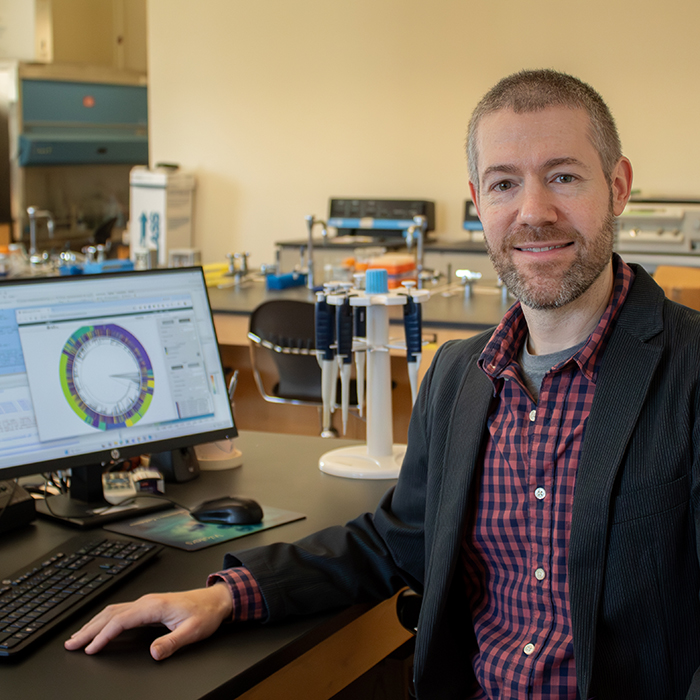
DUBUQUE, Iowa - University of Dubuque Professor of Biology Adam Kleinschmit, PhD, was part of a collaborative research team that published new findings challenging a long-standing assumption that animal venom is sterile.
The study, "Microbiota Discovered in Scorpion Venom," was published January 2026 in the peer-reviewed journal PLOS One. Kleinschmit led the bioinformatics analysis of the dataset, working closely with co-authors Barbara Murdoch, PhD, and Matthew Graham, PhD, professors of biology at Eastern Connecticut State University in Windham, Connecticut, and Carlos Santibanez-Lopez, PhD, assistant professor of genetics at Western Connecticut State University in Danbury, Connecticut.
Using sterile venom collection techniques and high-throughput DNA sequencing, the research team identified diverse bacterial communities living directly within the venom of two scorpion species: Beck's Desert Scorpion and the Eastern Swollenstinger Scorpion. This work is compelling as scorpion venoms represent an underexplored reservoir of bioactive molecules. The extreme environment of venom is a promising source of novel antimicrobial compounds that could inspire new antibiotics. The bioinformatics analysis revealed that each scorpion species, sampled from sites in the Mojave and Great Basin deserts, harbors a distinct bacterial community dominated by resilient microbial taxa.
"Bioinformatics harnesses computation tools to organize, process, and analyze large biological datasets," Kleinschmit said. "For this microbial ecology project, we specifically used computer-based tools to interact with a large dataset of DNA sequences that allowed us to identify which microbes were present and their relative abundance in scorpion venom."
Venom has traditionally been assumed to be sterile. However, recent studies in snakes and spiders have begun to overturn this view. "Microbiota Discovered in Scorpion Venom" builds upon that growing body of work with the first assessment of microbial diversity conducted examining the venom itself, beyond the gland tissue, to demonstrate that venom can be understood as a microbial ecosystem.
"Our research further shifts the traditional paradigm that venom is sterile due to the presence of antimicrobial peptides and toxins to thinking of venom as a microbial ecosystem that happens to be inhospitable for most organisms," Kleinschmit said. "In fact, it is possible that these venom microbes may play a role in generating and/or modifying venom compounds, an area of active venom biology research."
Adam Hoffman, PhD, vice president for academic affairs at UD, said Kleinschmit's commitment to work collaboratively with other researchers to explore the world is exactly what science is all about.
"His curiosity in examining microbial communities in scorpions, snow top mountains, and Iowa prairie soils shows the diverse and wide range application of his research," Hoffman said. "Our students benefit immensely from learning and researching with Professor Kleinschmit."
"Microbiota Discovered in Scorpion Venom" has far reaching implications. Kleinschmit shared how microbes capable of surviving in venom must tolerate intense chemical stress and nutrient scarcity, making them of particular interest for understanding biochemical resilience and life in extreme environments. The findings also point to potential applications in medicine and biotechnology such as the discovery of novel antimicrobial compounds, enzymes, or other biologically active molecules.
"More broadly, the work reshapes how scientists think about venom, not just as a weapon or toxin, but as a complex biological system shaped by interactions among animals, microbes, and their environment," Kleinschmit said.